


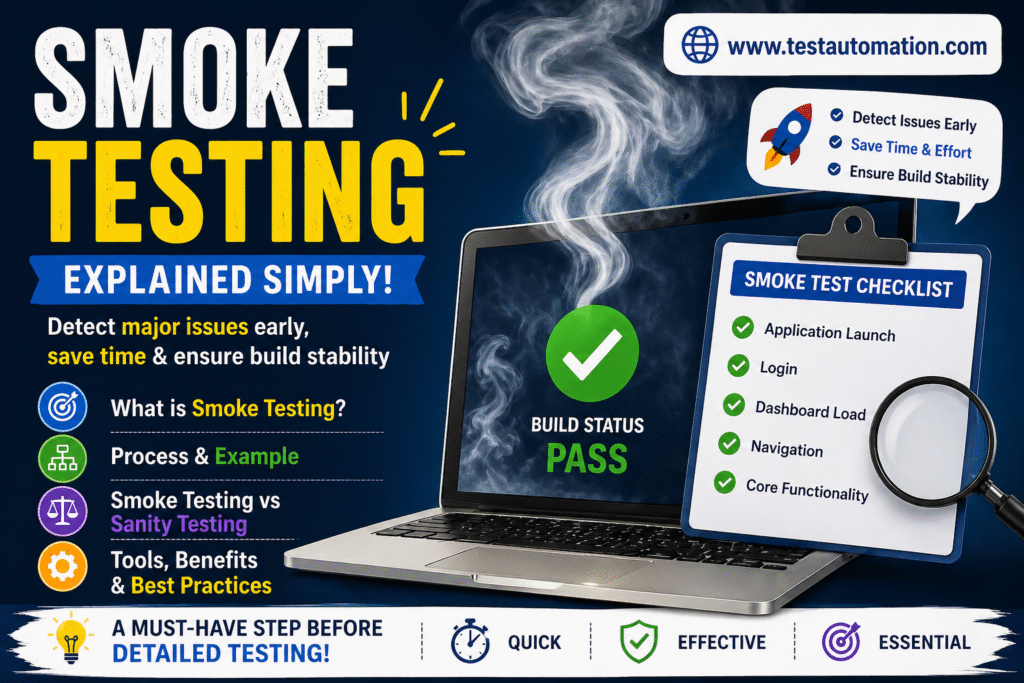
What is smoke testing?
If we ask a question about why software testing is required, then the answer to it is simple. Testing is done to make sure the application works correctly before it is used in production. But do you think it is practical to test software completely when a new build is released by the developer to test? No, it is not possible to test software entirely when there is a new build. Then what is the solution for it? How can we test it? The answer to this is by performing Smoke Testing.
It allows the test engineer to perform a quick check to see whether the main parts of the application are working, and, based on the smoke testing result, the build can be accepted for further deep testing or not. If the basic features fail, there is no point in doing deeper testing.
Definition of Smoke Testing
Smoke testing is a type of testing where we check the core functionalities of an application after a new build is released.
Goal of Smoke Testing
👉 “Is the build stable enough for further testing?”
Objectives of Smoke Testing
Smoke testing focuses on a few important goals:
- Make sure the build is stable
- Catch major issues early
- Save time for testers
- Avoid testing a completely broken application
When to Perform Smoke Testing?
Smoke testing is usually done in these situations:
- After a new build is received from developers
- After fixing critical bugs
- During continuous integration pipelines
- Before starting detailed testing
Limitations of Smoke Testing
- Covers only basic functionality
- Cannot find deep or hidden bugs
Learn a complete manual testing course here